
Prayed by Christians of every tradition
The Lord’s Prayer
Where it comes from
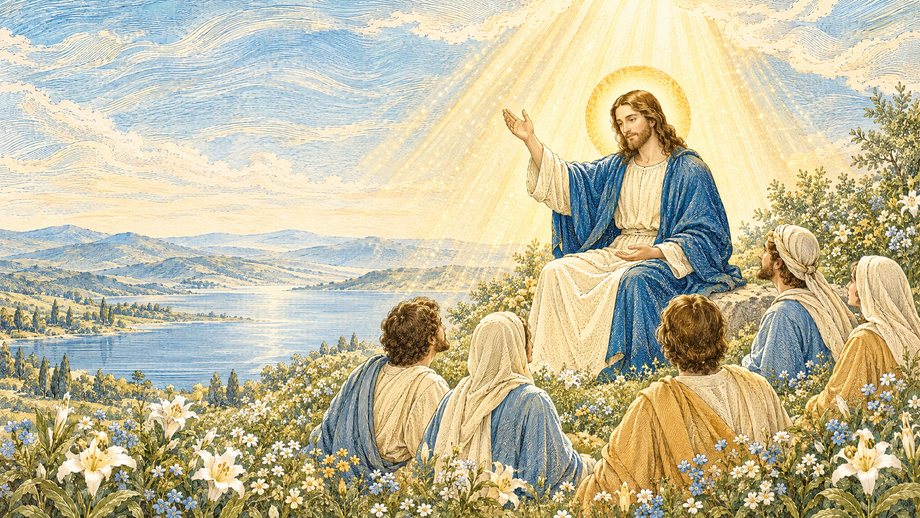
This is the prayer Jesus gave his friends. In Matthew’s Gospel it comes in the middle of the Sermon on the Mount, introduced with the words “After this manner therefore pray ye.” Luke tells it a little differently. There one of the disciples asks, “Lord, teach us to pray,” and Jesus answers with a shorter form.
The King James says “debts” and “debtors,” and many Presbyterian and Reformed churches still pray it that way. Many other churches say “trespasses.” That word came into English prayer through William Tyndale’s New Testament of 1526 and the first Book of Common Prayer in 1549. Jesus uses it himself in the very next verse: “For if ye forgive men their trespasses, your heavenly Father will also forgive you.” Luke’s version says “sins.” All three point to the same thing: what we need forgiven, and what we need to forgive.
The last line, “For thine is the kingdom, and the power, and the glory, for ever,” is in the King James but not in the oldest surviving copies of Matthew, and Luke doesn’t have it. A very similar ending appears in the Didache, one of the earliest Christian handbooks, so believers were praying it very early. The Prayer Book of 1662 includes it. Catholics end the prayer itself at “deliver us from evil,” and at Mass the people say the closing words a moment later as a response of their own. Whichever way you learned it, you learned it right.
The Lord’s Prayer
Our Father which art in heaven, Hallowed be thy name. Thy kingdom come. Thy will be done in earth, as it is in heaven.
Give us this day our daily bread. And forgive us our debts, as we forgive our debtors. And lead us not into temptation, but deliver us from evil:
For thine is the kingdom, and the power, and the glory, for ever. Amen.
Matthew 6:9-13, King James Version
How people pray it
You probably know this one by heart, even if you haven’t said it in years. That’s its gift. On the night you have no words of your own, these are already in you, waiting.
Try saying it slowly, a phrase at a time, and let each one land. “Give us this day our daily bread” is permission to ask only for today. The words “as we forgive our debtors” may stop you. Let it. Pause there and name one person, even if all you can honestly say is that you’re not there yet.
Say it with someone when you can, at the table or at a bedside. It begins with “Our,” not “My.” It was made to be prayed together.
More classic prayers
- Made by Catholic, Orthodox, Lutheran and Anglican Christians, and many more The Sign of the Cross
- A Catholic prayer, loved well beyond the Catholic Church The Hail Mary
- Said by Catholic, Orthodox, Anglican and Lutheran Christians, and many more The Glory Be
- Said by Catholic, Lutheran, Anglican, Methodist and Reformed Christians The Apostles’ Creed