
Made by Catholic, Orthodox, Lutheran and Anglican Christians, and many more
The Sign of the Cross
Where it comes from
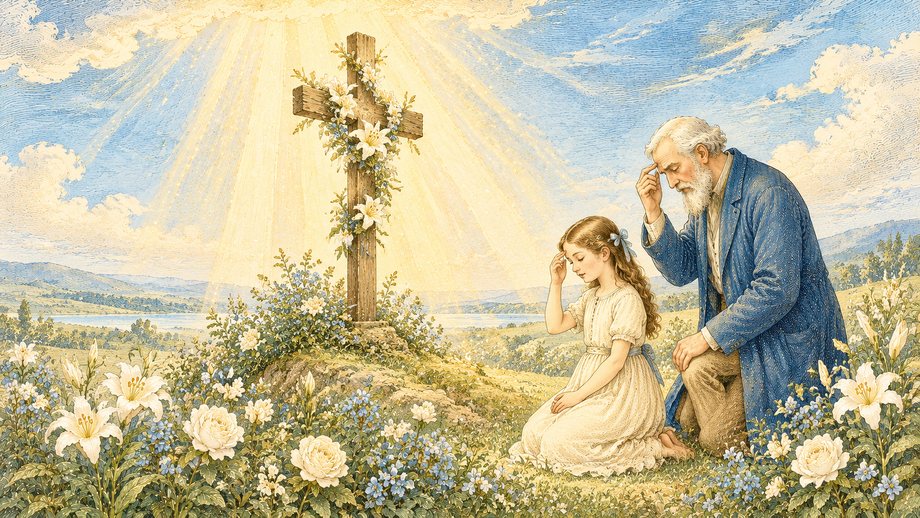
The Sign of the Cross is a prayer you say with your hand as well as your mouth. You touch your forehead, then your chest, then one shoulder and the other, tracing the cross on yourself, and you name God as Father, Son and Holy Spirit.
The words come from the end of Matthew’s Gospel, where the risen Jesus sends his friends out to every nation, “baptizing them in the name of the Father, and of the Son, and of the Holy Ghost” (Matthew 28:19). Older prayer books say “Holy Ghost,” and the Catholic wording below says “Holy Spirit.” They mean the same.
The gesture is very old. Around the year 200, a Christian writer in North Africa named Tertullian said believers traced a small cross on their foreheads when they came in or went out, when they dressed, at meals, and before they went to sleep. The larger cross, made across the whole body, came later.
Catholics, Lutherans and Anglicans move the hand from the left shoulder to the right. Orthodox Christians go from right to left, with three fingers held together for the Trinity. It was never only a Catholic prayer: Martin Luther’s Small Catechism tells Christians to bless themselves “with the holy cross” when they rise in the morning and when they go to bed.
The Sign of the Cross
In the name of the Father and of the Son and of the Holy Spirit. Amen.
The words of Matthew 28:19, said with the hand; traditional English wording
How people pray it
Make it as you begin to pray and again when you finish. Touch your forehead on “the Father,” your chest on “the Son,” and each shoulder in turn on “the Holy Spirit.” Then rest your hand for “Amen.” It takes about three seconds.
Because it is so short, it goes where longer prayers can’t. Before you eat. At the start of a long drive. When a siren goes by, or you walk into a room you’ve been dreading. Some parents trace a small cross on a child’s forehead at bedtime, the way Christians did in Tertullian’s day.
If you didn’t grow up with it, you are welcome to it. And if the gesture feels like someone else’s custom, say the words alone. Either way, you are putting whatever comes next inside the name of God.
More classic prayers
- Prayed by Christians of every tradition The Lord’s Prayer Matthew 6:9-13
- A Catholic prayer, loved well beyond the Catholic Church The Hail Mary
- Said by Catholic, Orthodox, Anglican and Lutheran Christians, and many more The Glory Be
- Said by Catholic, Lutheran, Anglican, Methodist and Reformed Christians The Apostles’ Creed